
What are molecular robots?
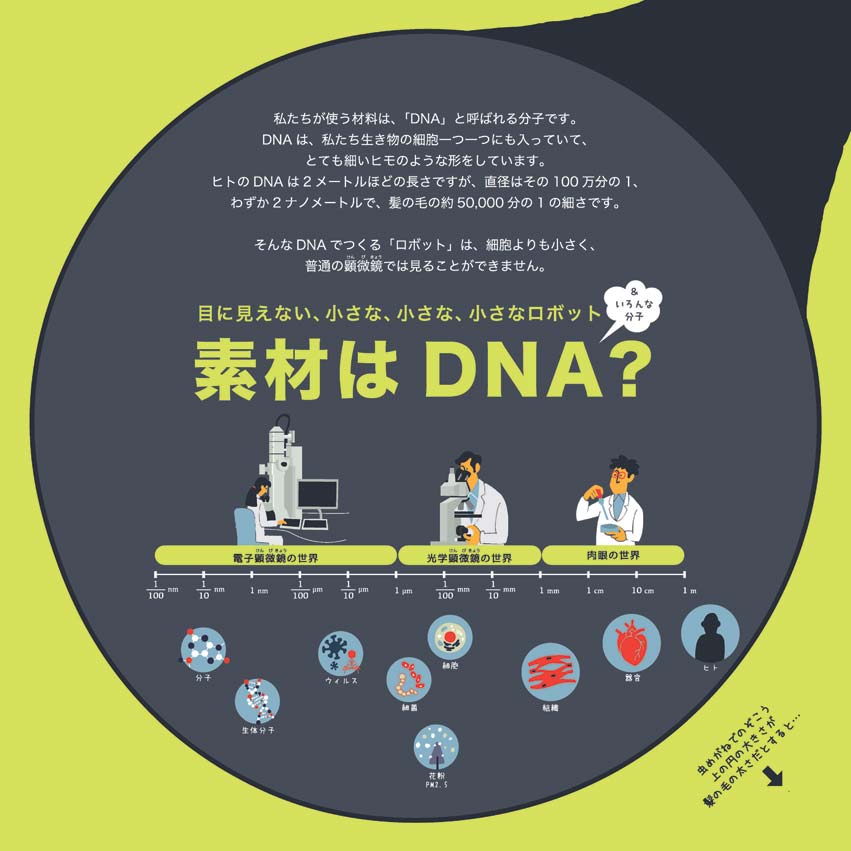
The material we use is a molecule called “DNA.”
DNA is found in every single cell of living organisms,
and it looks like a very thin thread.
Human DNA is about 2 meters long, yet its diameter is one millionth of that—
only 2 nanometers—about 1/50,000 the thickness of a human hair.
A “robot” made from such DNA is even smaller than a cell,
so it cannot be seen with an ordinary microscope.
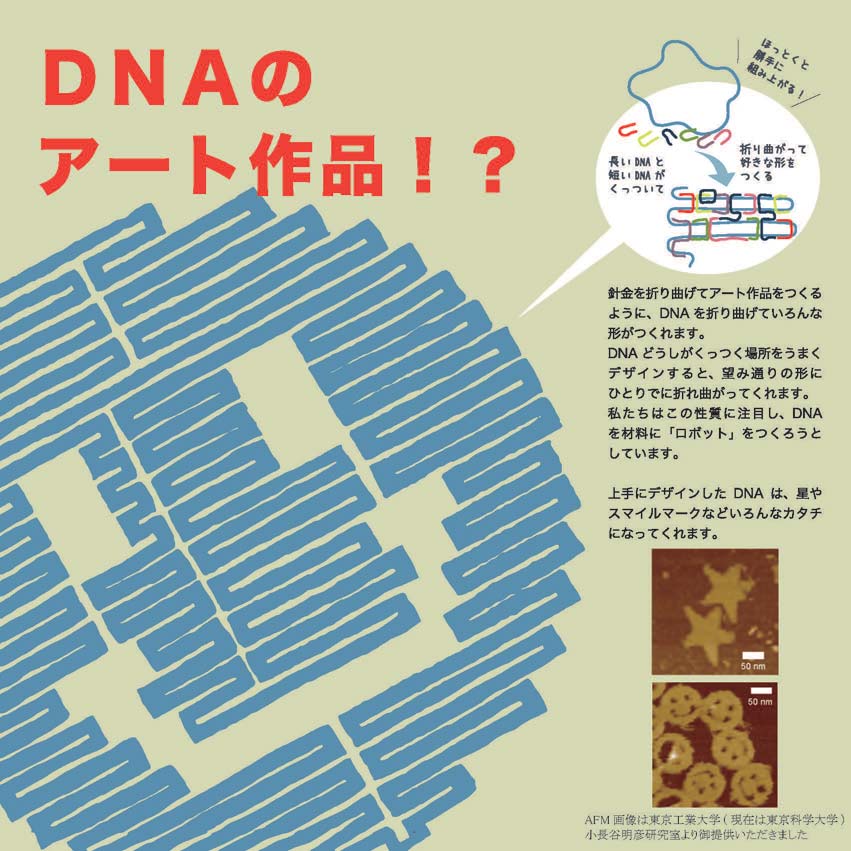
Just as you can bend wire to create artwork,
you can also fold DNA to make many different shapes.
By carefully designing where strands of DNA stick to each other,
the DNA will fold by itself into the shape you want.
We focus on this property and aim to build “robots” using DNA as a material.
Well-designed DNA can take on many shapes,
such as stars or smiley faces.
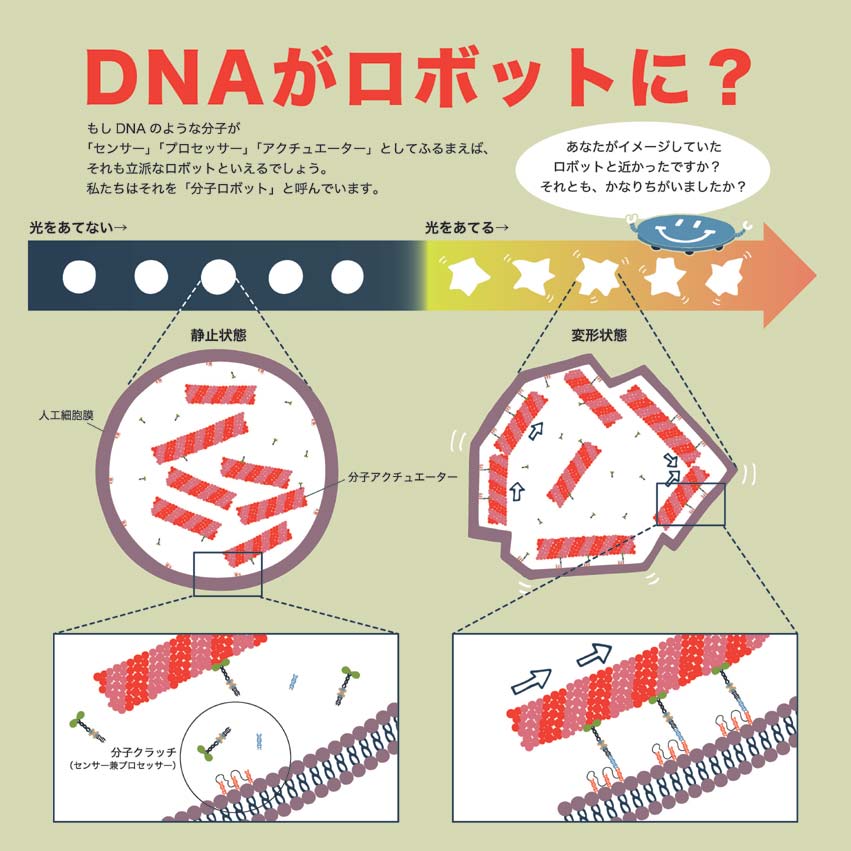
A robot has three key elements:
a “sensor,” a “processor,” and an “actuator.”
A sensor is the part that detects information from the environment, such as light or sound.
A processor is the part that processes the sensed information, “thinks,” and issues instructions.
An actuator is the part that moves in response to those instructions.

If molecules like DNA could function as a
“sensor,” “processor,” and “actuator,”
then they could certainly be called robots.
We call them “molecular robots.”
Molecular robots made of DNA have characteristics that are quite different
from today’s electrically powered robots.
For example, because they are made of the same kinds of materials as our bodies,
they are soft—and they might even be eaten by living organisms and become nutrients.
Also, like living things, they may be able to make copies of themselves.
And just as we are made of many cells, large numbers of molecular robots could gather together
and potentially do many kinds of tasks.

In the future, molecular robots like these may appear.
Would you accept them?
Would you want to try using them?

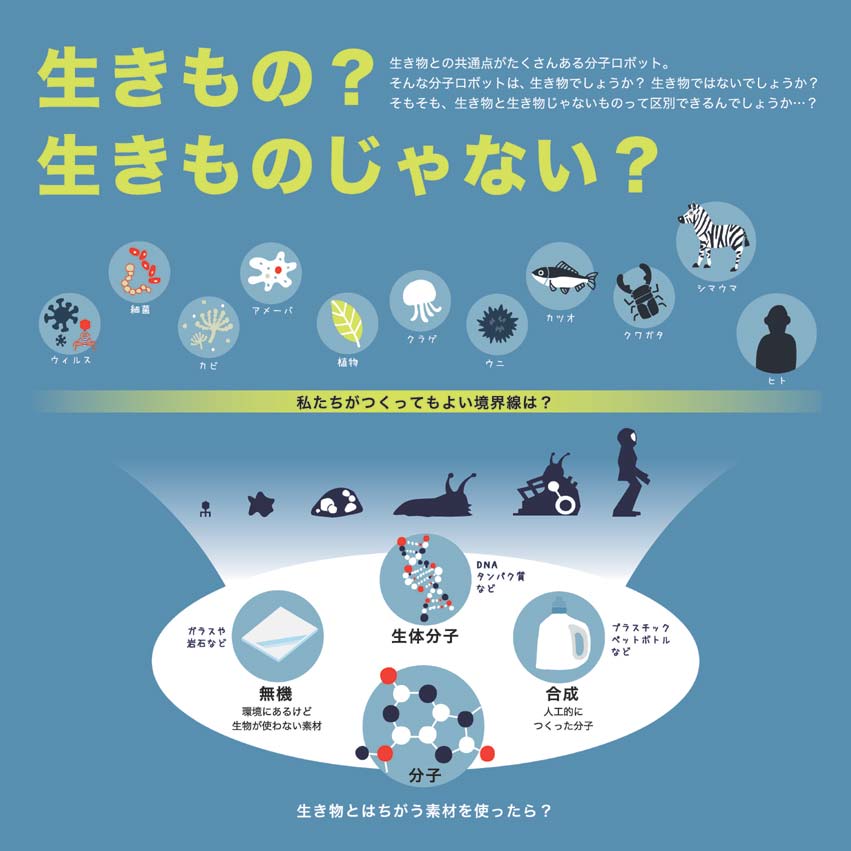
Molecular robots share many similarities with living things.
So—are they living? Or not living?
And in the first place, can we clearly distinguish living things from non-living things…?
The history of developing molecular robots has only just begun.
Right now, research is still at the stage of enabling molecular robots to do various things,
so it will take quite some time before they become something you can use.
Molecular robots are so small they are invisible to the naked eye,
and they are made of the same kinds of materials as living bodies.
Until now, there has been no concept or technology quite like “molecular robots.”
That means we still do not yet know what exactly we should aim for when building them,
or what we need to be careful about.
That is why we, as researchers, want to gather your voices—starting now,
even before we fully know what molecular robots will ultimately be able to do—
from those of you who may use molecular robots in the future.
After learning about molecular robots,
did you feel any hopes or expectations—or any worries?
Is there anything you would like to discuss further?